 English
 Français
 Deutsch
 euskara
 Русский язык
 Italiano
 Português
 Nederlands
 Polski
 Greek
Greek Lietuva
 Türkçe
 日本語
日本語 한어
한어 中文
中文 தாமில்
 فارسی
فارسی हिंदी
हिंदी Tiếng Việt
 ภาษาไทย
 Pilipino
 Indonesia
 தாமில்

Precision at Scale: AO Devices Push Quantum Computing Past 1,000 Qubits
The core principle behind optical quantum computing is simple: create and control qubits with lasers. In practice, scaling such a system beyond a few hundred qubits is a complex endeavor. It involves generating, steering, modulating, and stabilizing thousands of diffraction-limited beams with microsecond-class latency across a millimeter-scale field of view.
Acousto-optic (AO) devices - including deflectors (AODs), modulators (AOMs), and AO multichannel (AOMCs) architectures - all present unique solutions to the implicit challenges of scaling qubits, which has helped propel AO devices from auxiliary optics in quantum computing architectures to core infrastructure (Figure 1).
Two papers - both published by Nature in September 2025 - detail demonstrations that explicitly illustrate this trend.
One article, titled “A tweezer array with 6,100 highly coherent atomic qubits,” describes a neutral-atom array that demonstrated large-scale coherent control and atom transport across a dense tweezer lattice. The experiment used transport tweezers driven by a pair of crossed Gooch & Housego (G&H) AODF 4085 AODs to move atoms between regions of the array.
The second article (“Continuous operation of a coherent 3,000-qubit system”) describes a continuously operating 3,000-qubit neutral-atom system that exhibited sustained steady state operation with active atom rearrangement. Two perpendicularly mounted G&H AODF 4085 devices formed the core of the 2D beam steering system used for atom sorting, transport, and lattice maintenance.
Together, these articles underscore a key point about scaling optical qubit platforms: As quantum computing systems move from hundreds to thousands of qubits, fast, widefield, electronically controlled beam steering becomes indispensable. At these scales, the optics must deliver a wide field of view, high resolution (as measured by the number of distinct addressable points), and steering speeds on the order of microseconds without relying on mechanical scanning.
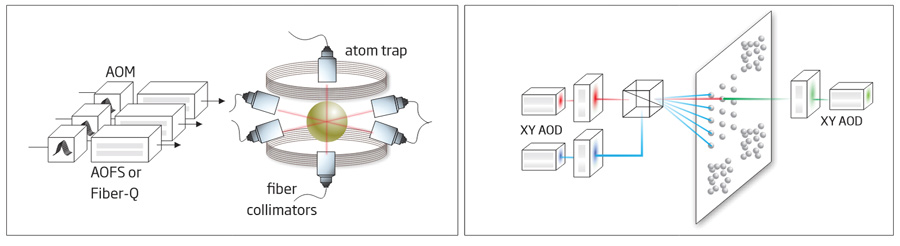
Figure 1 - By addressing key challenges in beam steering, modulation, and parallel control, acousto-optic defectors, modulators, and multichannel architectures have become essential infrastructure for scaling quantum computing platforms.
Amplitude and frequency agility
Quantum processors require precise, highspeed control over optical amplitude and frequency. This is where AOMs and acousto-optic frequency shifters (AOFS) play a central role.
AOMs provide high-bandwidth intensity modulation, enabling clean switching and finely shaped optical pulses on time scales ranging from the nanosecond to the microsecond domain. They can also enable the stable, well-defined frequency shifts needed to address specific atomic transitions and compensate for slow drift elsewhere in the system. In neutral-atom quantum computers, these capabilities support fast power stabilization for traps and control beams, pulse shaping for single-qubit rotations and multi-step gate sequences, and frequency agility to either selectively address transitions or dynamically retune beams.
Similar considerations apply to trapped-ion quantum computing, where AOMs are widely used to route, gate, and stabilize laser beams for individual ion addressing and entangling operations.
Fast and efficient beam steering
Quantum computing power scales exponentially with the number of qubits, and the practical challenges scale accordingly. At large qubit counts, three requirements become unavoidable: moving atoms to organize arrays and fill empty sites, transporting qubits across the processor without degrading coherence, and shuttling atoms between storage, interaction, and readout zones. High-performance AODs uniquely satisfy these needs by combining speed, coverage, and fine spatial resolution in a single optical element.
Optimized AOD design enables several core advantages that become decisive at large qubit counts:
Speed (low-latency beam steering): At thousands of qubits, latency directly impacts usable compute time. AODs steer beams electronically on microsecond time scales, allowing fast atom replenishment so the processor spends more time computing and less time rebuilding.
Coverage and resolution (wide-field, fine control): Thousands of sites spaced a few microns apart must fit within a millimeter-scale field. Wide-aperture AODs provide the angular range, resolution, and repeatability needed to steer diffraction-limited beams across this field without sacrificing precision.
Power efficiency (thermal scalability): Large qubit arrays operate under tight thermal constraints. The high acousto-optic figure of merit of optimized AODs delivers strong diffraction efficiency at modest radio frequency (RF) power to enable dense, high-duty-cycle operation.
Algorithmic control (software-defined optics): Manual tuning does not scale to thousands of qubits. Electrically controlled AODs integrate naturally with closed-loop calibration, allowing RF waveforms to be updated algorithmically as systems scale toward 10,000-qubit architectures and beyond.
The result is a technology platform that naturally supports the rare combination of wide steering range, fine spatial resolution, and fast response required to manipulate thousands of tightly packed atomic qubits. Figure 2 shows that G&H AODs routinely support large optical apertures, broad RF bandwidths, and well over 1,000 resolvable spots.
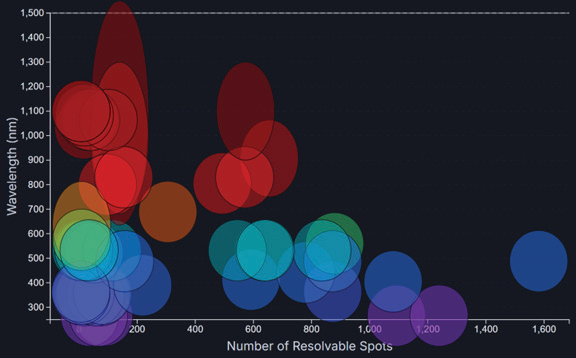
Figure 2 - Application Wavelength vs Resolvable Spots for a selection of G&H AODs. This graph illustrates the combination of large aperture, broad RF bandwidth, and high spot count (>1,000) achievable with G&H acousto-optic deflectors.
Scalable optical control for now and the future
AO technology can significantly ease quantum scaling by boosting the number of qubits that can be addressed through one optical control channel. Multi-tone RF operation allows a single AOD to simultaneously manipulate multiple optical beams (multiplexing). Beyond this, G&H multichannel AO devices are already available with more than 64 independent channels, enabling further scaling through parallel processing.
These core AO capabilities are contributing to the development of large-scale quantum processors that share an emerging architecture, wherein spatial light modulators provide dense, quasi-static trap arrays; AODs deliver fast dynamic tweezers for transport, sorting, and routing; and AOMs supply high-bandwidth amplitude and frequency control. Together, these elements allow a single optical module to provide many independently controlled beams in parallel. This reduces optical complexity while improving stability and scalability in support of future large-scale quantum systems.
For more information on our AOM, please click here.