 English
 Français
 Deutsch
 euskara
 Русский язык
 Italiano
 Português
 Nederlands
 Polski
 Greek
Greek Lietuva
 Türkçe
 日本語
日本語 한어
한어 中文
中文 தாமில்
 فارسی
فارسی हिंदी
हिंदी Tiếng Việt
 ภาษาไทย
 Pilipino
 Indonesia
 தாமில்
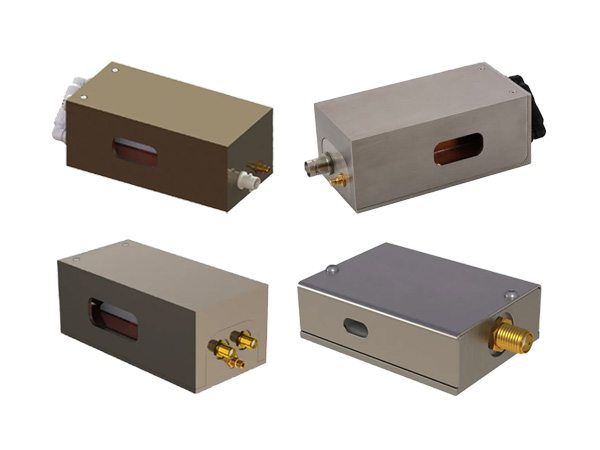

High-precision Local Beam Deflection: G&H Acousto-Optic Deflector (AOD) Technology
With the development of semiconductor, consumer electronics, PCB microvia drilling and precision laser manufacturing toward miniaturization, high density and high efficiency, traditional galvanometer scanning systems face stricter requirements for high-speed response and fine positioning. G&H Acousto-Optic Deflectors (AOD) achieve rapid laser beam deflection via acousto-optic interaction. They can work in tandem with galvanometer scanning systems to combine large-area scanning and local high-speed precision positioning. Sintec Optronics provides photonic component selection and technical support for precision laser machining, microelectronics manufacturing and research applications, based on G&H acousto-optic devices and matching RF driver technology.
Why do we need AOD for precision laser machining?
In semiconductor manufacturing, PCB fabrication, micro material processing and precision laser machining, systems require not only high-speed scanning but also high-precision, repeatable beam positioning within tiny regions.
Conventional laser scanning systems adopt galvanometer scanners, where motor-driven mirrors steer laser beams to realize 2D scanning. This solution offers wide scanning range, mature technology and broad adoption. However, the reflective mirrors carry rotational inertia. Their response during high-frequency small-step movements is limited by motor torque, mirror size and control algorithms. As feature sizes shrink and processing points multiply, with point spacing down to micron level, galvanometer-only scanning struggles to balance throughput and fine positioning in some high-speed, high-density scenarios.
G&H AOD delivers an alternative technical approach. An AOD uses RF signals to generate acoustic waves inside an acousto-optic crystal. The interaction between acoustic waves and incident laser modifies the refractive index distribution and steers the beam. AOD contains no moving reflective mirrors. Beam position is determined by RF frequency, and beam switching time depends on acoustic propagation time. It compensates the weakness of galvanometers in local high-speed positioning. On the downside, AOD has a small deflection angle. Typically, galvanometers or motion stages perform large-range positioning while AOD handles fast beam deflection within local areas. This architecture fits applications demanding high-speed, fine beam control. For systems requiring both large-format scanning and micro-area high-speed machining, AOD + galvanometer combined solutions deliver greater value.
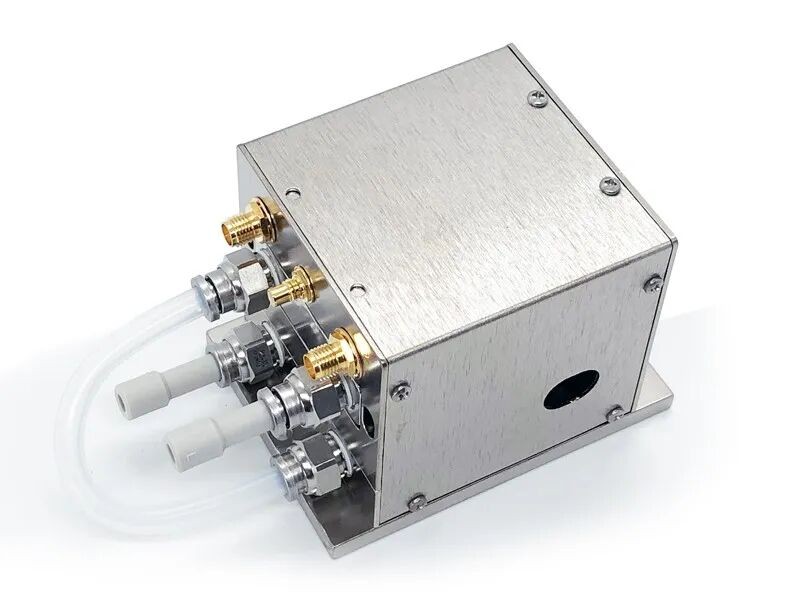
Operating Principle of G&H AOD
G&H AOD consists of acousto-optic crystal, piezoelectric transducer and RF driver.
1.RF input: The RF driver generates RF signals with defined frequency and power and feeds them to the acousto-optic device.
2.Acoustic wave generation: Acoustic waves form inside the crystal, creating time- and space-variant refractive index grating.
3.Laser beam deflection: Incident laser interacts with the acoustic grating to alter the propagation direction of the diffracted beam.
4.Beam position control: Adjusting RF frequency changes the diffraction angle; adjusting RF power controls diffraction efficiency and other optical responses within the operating window.
Actual AOD performance depends not only on crystal material and device design, but also RF driver, laser wavelength, beam diameter, incident angle and control algorithm. When evaluating AOD, engineers should review not only maximum deflection speed, but also effective scan range, diffraction efficiency, positioning accuracy, response time, optical power handling and system integration requirements.
AOD vs Galvanometer Scanner
AOD and galvanometer scanners differ in working principle and performance. They are not simple substitutes but serve distinct beam control tasks.
The acousto-optic deflector (AOD) achieves beam steering through acousto-optic interaction, which forms a diffraction grating inside the crystal; the diffraction angle changes by tuning RF frequency. There are no moving parts within an AOD, and beam deflection is controlled purely via RF signals. It features ultra-fast beam position switching, subject to the performance of the device and its driver. The total deflection angle of AOD is small; standard G&H products typically range from around 5 mrad to over 60 mrad. It is designed for fine deflection within a limited angular range. The position switching time sits at the microsecond scale, determined by access time calculated as beam diameter divided by acoustic velocity. The first-order diffraction efficiency of G&H AOD reaches approximately 70%–85%; cascaded 2D AOD setups multiply the optical losses. The deflection angle is proportional to laser wavelength, which introduces chromatic dispersion for broadband light sources. Its optical power handling capacity is limited by crystal damage threshold and thermal effects, which must be verified according to the target wavelength and laser power. AOD is controlled by RF frequency and power and requires a matched RF driver. Its core strengths lie in high-speed deflection and fine positioning with no moving mirrors. Key factors for AOD selection include wavelength, deflection angle, RF bandwidth, diffraction efficiency, optical power and response time. AOD is commonly used for local high-speed deflection, microvia and micro-structure machining, and multi-point beam switching. For system integration, a matched RF driver and optical control system are mandatory.
By contrast, the galvanometer scanner, or galvo, implements mechanical beam steering via a motor-driven mirror assembly. It has moving components including mirrors and motors. Beam control is realized by adjusting mirror angles through the galvo motor and controller. Its dynamic response is constrained by motor inertia, mirror size and control system performance. Galvo offers a large total deflection angle; for example, the SCANLAB intelliSCAN IV series features a typical scan angle of ±0.35 rad. It supports large scan angles and wide processing fields. Position switching time is at millisecond or sub-millisecond level and varies with mirror aperture, step size and control method. Optical efficiency depends on mirror coating and is generally higher than that of AOD. The reflection angle is nearly wavelength-independent. Its power handling is limited by coating damage threshold and thermal distortion. Galvo accepts position commands via control cards such as XY2-100 and SL2-100. Its main advantages are large-area scanning and mature system integration. Engineers select galvo mainly based on scan field, positioning accuracy, dynamic performance, beam quality and laser power. Typical applications include large-area scanning, marking, welding and cutting. Galvo systems need to be equipped with a galvo controller and F-theta lens for integration.
Engineering recommendation: Use galvanometer-first if your task prioritizes large-range scanning. Choose AOD for rapid multi-point switching within confined regions. For systems needing both large field and local high-speed precision positioning, evaluate AOD+galvo combined architecture. Final performance shall refer to datasheet specifications, system design and real test results.
AOD + Galvo Combined System: Wide Scan + Fine Positioning
For high-density micro-structure machining, a single scanning device can hardly satisfy scan field, positioning accuracy and throughput simultaneously. The hybrid setup splits workload: galvanometer/motion stage moves the beam to target zone; AOD rapidly shifts beam position within this zone to fabricate tiny features or dense point arrays. The control system synchronizes galvo position, RF frequency and laser trigger in time sequence.
The local scan coverage of AOD at workpiece plane ≈ F-theta focal length × AOD deflection angle. Example: 100 mm focal length + 40 mrad deflection → ~4 mm local scan area. If beam relay or beam expander sits between AOD and F-theta lens, the angle scales with magnification. Actual coverage depends on optical layout.
Integration checklist:
Coverage: AOD local scan window must exceed galvo positioning error, with overlap for stitching adjacent tiles.
Coordinate mapping: Calibrate galvo coordinates against RF frequency and compensate field distortion.
Timing synchronization: Wait for one access time after RF frequency update before firing laser.
Energy uniformity: 1st-order efficiency varies with frequency. Review flatness spec and compensate RF power if needed.
Thermal stability: RF power variation causes crystal temperature drift, inducing pointing and efficiency drift. Cooling and preheating are required for continuous operation.
Overall system performance depends on coordinated design of all components and control algorithms, and cannot be judged solely by standalone device speed.
Main Application Fields of G&H AOD
PCB Microvia Drilling & Precision Circuit Machining As PCB circuit density rises and microvia quantity increases, machines must locate and process massive fine points quickly. AOD handles local high-speed beam deflection and works with galvo systems to boost scanning efficiency for dense microvia arrays. Feasibility depends on hole size, pitch, substrate structure, laser wavelength and pulse parameters.
Semiconductor Wafer Machining & Inspection Laser is used for wafer dicing, micro-structure fabrication and selected inspection tasks. AOD delivers high-speed beam positioning and local scanning capability. Suitability shall be verified against wafer material, machining depth, heat-affected zone requirement, laser wavelength and positioning error.
Precision Machining for Consumer Electronics Consumer electronics trend toward thin profile and high integration, demanding micro holes, fine patterns and complex micro-structures. In qualified laser systems, AOD enables fast beam deflection for fine patterning and multi-point scanning. Final results depend on material properties, optical layout and process parameters.
Micron-scale Material Processing For multi-point machining, fine contour scanning or dense patterning within small areas, AOD offers non-mechanical beam steering. At system design stage, evaluate beam quality, deflection range, focused spot, positioning error and throughput to match device performance with process requirements.
LiDAR & Scientific Optical Systems Beyond industrial manufacturing, AOD applies to beam scanning and optical lab setups. For quantum optics and precision research, acousto-optic components serve beam modulation and experimental control, subject to system design.
RF Driver & Acousto-Optic Crystal: Core Factors Affecting AOD Performance
AOD does not operate alone. Matching between RF driver, crystal and optical system dominates overall performance.
RF Driver RF driver generates and regulates RF signals for AOD. Key selection criteria: operating frequency range & bandwidth, RF output power range, frequency switching speed & stability, synchronization between RF switching and laser trigger, control interface, modulation scheme and thermal management for continuous operation. RF driver parameters must match the specific AOD model.
Acousto-Optic Crystal Crystal material determines working wavelength, diffraction efficiency, acousto-optic figure of merit, thermal behavior and power handling. G&H offers TeO₂, sapphire and fused quartz options. Optical and acoustic properties vary by material; refer to product datasheets.
AR Coating & Optical Loss Anti-reflection coating reduces surface reflection loss and improves transmission. Verify coating specification against laser wavelength, incident angle, polarization and optical power during selection.
Thermal Stability & Long-term Reliability For industrial mass production, thermal drift on deflection angle, diffraction efficiency and beam pointing, plus long-run stability of RF driver and optics, are critical besides nominal performance. AOD selection shall be based on model specs and application tests.
G&H AOD Selection Parameters
Engineers shall clarify the following parameters when evaluating G&H AOD: Laser wavelength; beam profile (1/e² diameter, ellipticity, polarization, M²); average / peak laser power; pulse parameters; required deflection angle & scan area; RF frequency & bandwidth; diffraction efficiency & flatness; response time; positioning accuracy & repeatability; matched RF driver; integration with galvo, F-theta lens and controller; ambient & cooling requirements.
Note: Trade-offs exist between maximum deflection angle, effective scan range, positioning accuracy and response time. Optimize against your machining task and mechanical layout instead of maximizing single indicator. If model selection is not finalized, provide laser wavelength, power, pulse specs, target scan range, point pitch and throughput for preliminary component matching.
Sintec Optronics: G&H Acousto-Optic Device Selection & Optical System Support
Sintec Optronics specializes in core laser photonic components, precision optics and opto-mechanical solutions for laser processing, metal additive manufacturing and high-end optical equipment. We provide one-stop technical consultation and component selection services covering G&H’s complete acousto-optic product portfolio, including FiberQ, AOM, AOD, AOQS, AOFS, AOTF and Q-Switch. We offer integrated optical modulation solutions tailored for both research and industrial systems.
For applications requiring high-speed beam deflection and fine positioning, Sintec Optronics provides selection support for G&H acousto-optic devices and RF drivers for OEM machine builders, laser system integrators and research institutes.
During project evaluation, we assess compatibility between AOD, RF driver and your existing optical path based on laser wavelength, output power, scan range, positioning accuracy, throughput and control interface requirements.
For inquiries on G&H AOD or matching RF drivers, please provide:
Laser wavelength and average / peak power
CW or pulsed laser and pulse specifications
Required deflection angle or scan area
Target positioning accuracy and machining throughput
Integration with galvo, F-theta lens and existing control system
Application scenario and technical challenges
For more information on our AOD, please click here.